
Hialeah Directory Collections by Era
Hialeah incorporated in 1925, while Dade County records reach much farther back. That chronology changes the catalog search. Early residents may appear in Miami-area or countywide works rather than a title devoted to Hialeah. The public catalogs confirm several landmarks, but they do not publish a complete year-by-year Hialeah shelf list. Exact holdings should be checked with library or archive staff before a visit.
| Collection | Years | Where held | Access |
|---|---|---|---|
| First Miami telephone directory reprint | 1889 | Florida Memory and State Library | Free digitized item |
| Miami/Dade directory, guide and history | 1896-97 | HistoryMiami and MDPLS Florida Collection; reprint at University of Miami | Catalog and reading room |
| Miami city directories | Confirmed early issues including 1904; full run not listed online | HistoryMiami Tebeau Library and MDPLS Florida Collection | Appointment or in-library |
| Selected U.S. city directories | 1860s-1940s | MDPLS Main Genealogy Collection | In-library, catalog by city and year |
| Reverse address sections | Some Miami issues; Hialeah-inclusive years not enumerated | HistoryMiami and MDPLS | Inspect each volume |
| Miami-Dade Obituary Index | 1896-2008 | MDPLS online and Main Library microfilm | Free index; source text varies |
| State census schedules | 1885, 1935, 1945 | MDPLS microform | In-library |
| Federal census schedules | Released through 1950 | NARA and library databases | 72-year restriction |
This is a confirmed-coverage table, not a claim of a continuous city directory run. Ask for the title page, publication year, geographic coverage, and contents. A “Miami” title may include broader Dade places, but inclusion must be checked in that edition.
Search Hialeah Names at MDPLS
The MDPLS Main Library Genealogy Collection holds more than 27,000 bound volumes and 35,000 microforms. Materials are arranged first by state and then by subject. Beyond city directories and telephone indexes, the room includes Florida censuses, passenger lists, World War I draft cards, and Miami airplane alien-arrival records from 1930 through 1942. Most items require in-library use.
Reference staff can confirm a call number or likely volume before travel. Contact genealogy@mdpls.org or 305-375-5572. State the name variants, the closest known date, the Hialeah or Miami-Dade address, and whether a street-order section is needed. Staff cannot create a continuous run where none is cataloged, but a focused request saves time.
Review the official MDPLS genealogy collection description beside the captured page.
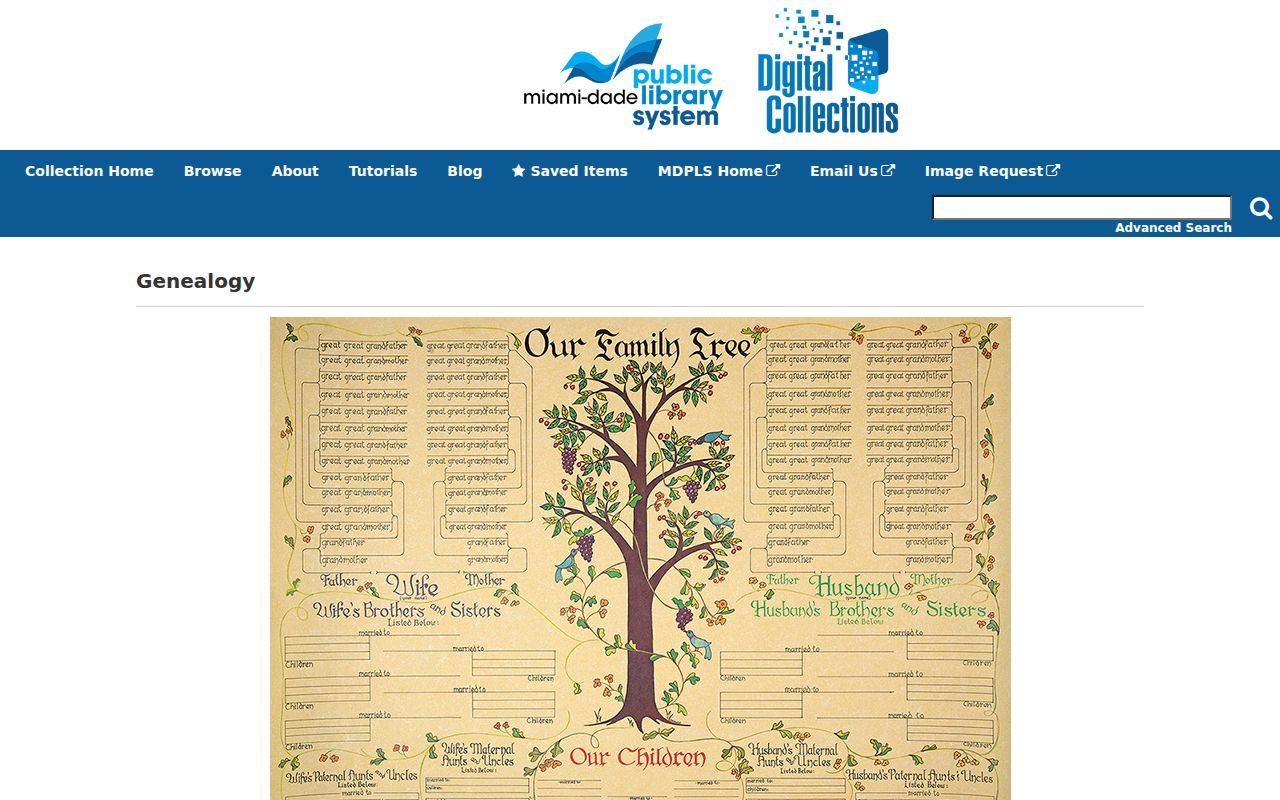
The collection page shows why a Hialeah city directory search should extend to census, surname, and microform holdings instead of stopping at one catalog title.
Read a Hialeah Directory Entry
Early Miami-Dade directory conventions usually place residents and businesses in alphabetical order. Some issues also contain essays, photographs, advertisements, and an address section. A typical entry may give a surname, first name or initials, occupation or business, spouse in parentheses in later styles, and a home or work address. Telephone books tend to show less household detail.
| Name | Surname and given name or initials; spelling must be tested against variants. |
|---|---|
| Occupation or business | The listed trade or firm, useful for distinguishing two people with the same name. |
| Spouse | Sometimes shown in parentheses in later conventions; not present in every issue. |
| Address | Residence or business address as printed for that edition. |
| “wid” | An abbreviation for widow, often followed by the deceased spouse's name. |
| “r” | An abbreviation for residence in the confirmed early convention. |
Photograph or transcribe the edition's own abbreviation key before copying entries. Publishers changed their codes. Do not add an owner or renter meaning unless that specific volume defines a symbol for it.
- Criss-cross directory
- A street-order section that reverses the usual name search, listing entries by road and house number.
- Householder index
- An address-based listing of the person or subscriber selected by the publisher, not every household member.
- Abbreviation key
- The volume's legend for shortened words and status marks; it controls how that edition should be read.
Hialeah Before Its Own Listings
Florida Memory offers a digitized reprint of Miami's first telephone directory, dated 1889. It is a telephone artifact, so expect subscriber names and exchange information rather than the detail of a later residential volume. Even so, it sets an early benchmark for named local communication records.
The rare 1896-97 Miami/Dade directory, guide, and history survives at HistoryMiami and MDPLS, with a reprint also cataloged at the University of Miami. Only three originals were known when it was reprinted. Its Dade geography was much larger than today's county and then included areas now in Broward and Palm Beach counties. A Dade hit must be located on a period map before it is treated as near Hialeah.
Open Florida Memory's item record before viewing the preserved directory page.
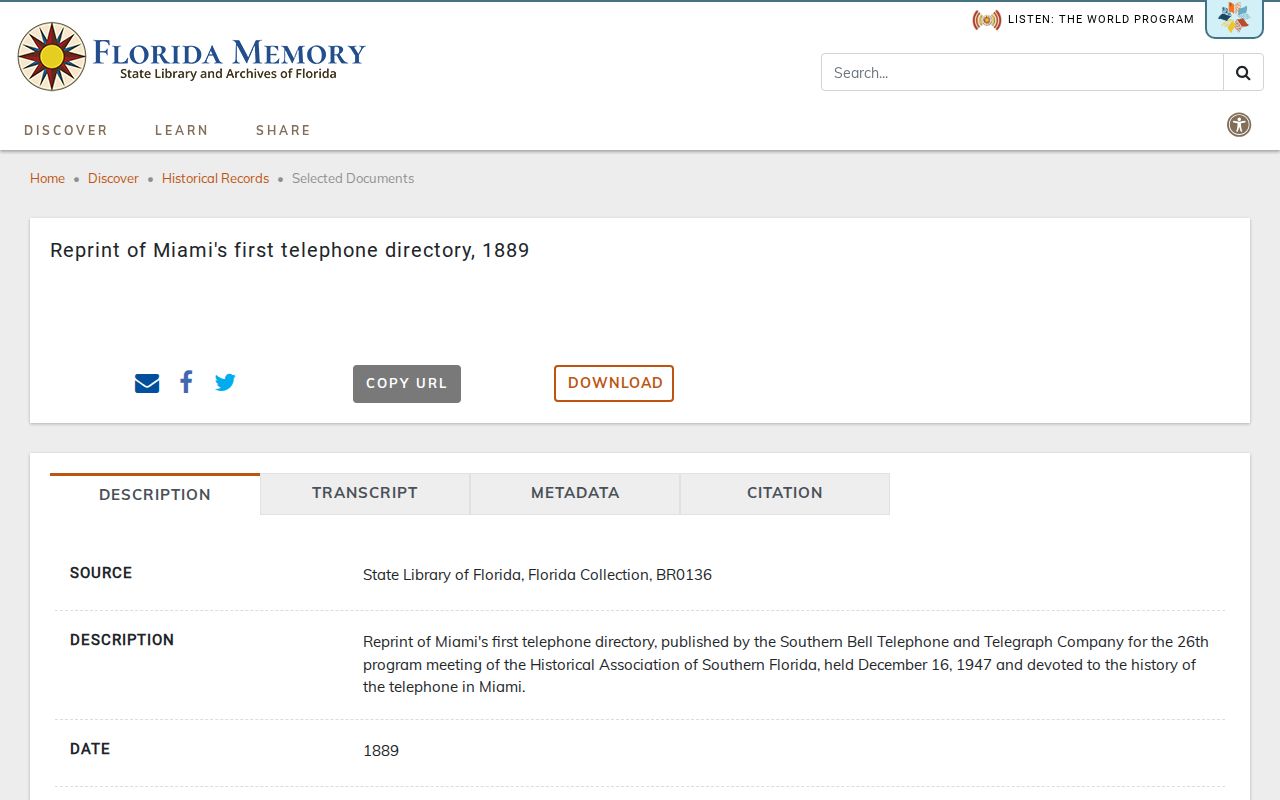
The item metadata fixes the date and source. It does not turn every subscriber into a Hialeah resident, which did not yet exist as an incorporated city.
Hialeah Directory Research Timeline
A short timeline helps choose the right shelf and place name. Local record history did not begin with city incorporation, and Hialeah's early library story explains why continuous municipal volumes should not be assumed.
| Year | Directory or record milestone |
|---|---|
| 1845 | A Florida State Archives Miami election return names voters decades before Hialeah existed. |
| 1889 | Miami's first telephone directory is represented by a digitized reprint. |
| 1896-97 | The rare Dade directory, guide, and history provides a countywide early benchmark. |
| 1904 | An early Miami directory is confirmed among historical-organization reprints. |
| 1924 | Hialeah's first library effort began with about 50 books gathered by the Women's Club. |
| 1925 | Hialeah incorporated, changing how later catalogs and local records may be labeled. |
| 1926 | A hurricane badly damaged the portable-school library collection; the group rebuilt at City Hall. |
| 1965 | The John F. Kennedy Memorial Library opened in July. |
The hurricane loss concerned the local library collection, not the county deed books. It should never be enlarged into an unsupported courthouse-record-loss story.
Hialeah Research at HistoryMiami
The HistoryMiami Research Center holds city directories, yearbooks, newspapers, maps, architectural drawings, family and organization papers, oral histories, and the Tebeau Library's local material. Its photographic collection spans 1883 to the present and contains about 1.5 million prints and negatives. The Wilkins Architectural Archives may connect an address with plans or design history.
Research is by appointment Tuesday through Thursday from noon to 4:30 p.m. and Friday from 10 a.m. to 4:30 p.m. Contact archives@historymiami.org or 305-375-1623. Send exact names, dates, addresses, and known directory titles so staff can identify boxes or volumes before the appointment. Reproduction fees may apply.
Check the official Research Center access details before viewing the archive capture.
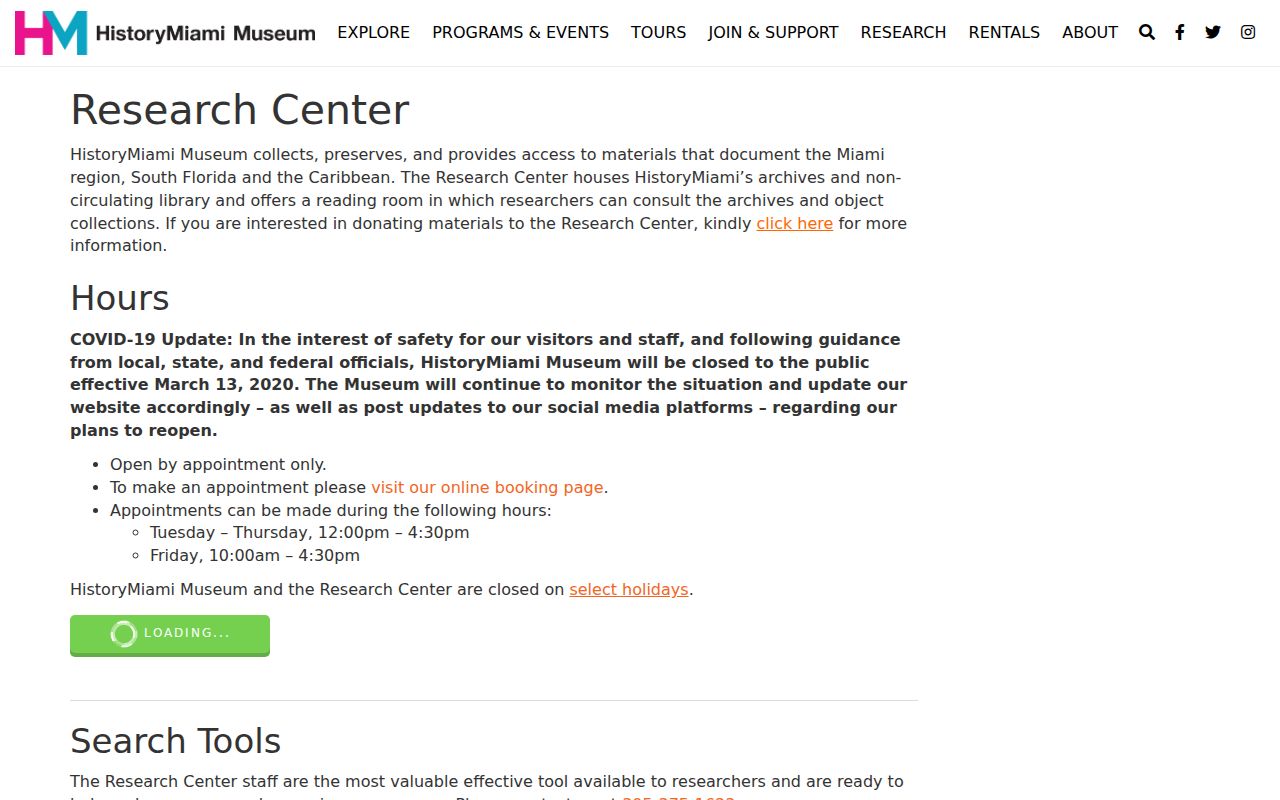
The appointment model matters: catalog and staff contact come before browsing, especially for photographs, architectural files, and scarce directories.
Reverse Hialeah Directory Searches
An address section turns a name-first volume into a street tool. Find the street, then the house number, and copy the listed resident or business exactly as printed. Check the entries immediately before and after it. Number gaps may show missing addresses, but they can also reflect vacant property, publisher omission, or a part of Hialeah outside that issue's coverage.
Compare the address with the alphabetical entry for more context, then inspect the prior and next available volumes. If the street label changes, use a subdivision, legal description, or parcel record to bridge the old and new form. The modern address chain belongs in the Hialeah street directory; historical city directories should supply the listed person, not overwrite a deed or current parcel card.
Note: An address-section entry proves inclusion by that publisher for that edition, not a complete census of the Hialeah household.
Trace Families in Hialeah Directories
Follow a household on a worksheet that preserves the exact source, year, spelling, occupation, spouse, and address. Hialeah's large Cuban and broader Latin American community makes two-surname and compound-name searching important. Test maternal and paternal order, hyphens, accents and accentless forms, initials, and Spanish or Anglicized given-name variants. Never assume the second surname is a middle name.
- Begin with the directory year closest to a known event and copy the entry verbatim, including abbreviations.
- Check the preceding and following available volumes for the same name, spouse, occupation, and street address.
- Use any address section to see who the publisher listed at the site after the person moved or disappeared.
- Pair the trail with Florida's 1935 and 1945 censuses and released federal schedules through 1950.
- Use the obituary index, probate docket, newspapers, or cemetery sources to explain a final disappearance.
A gap can mean a move, death, unlisted phone, missed canvass, renamed street, or missing volume. Do not pick one explanation until another record supports it. Deeds identify owners, while directories and censuses are more useful for the household layer.
From Hialeah Entry to Obituary
The MDPLS Obituary Index covers 1896 through 2008 and contains more than 915,000 names. Search controls include first, middle, and last name plus publication start and end dates; at least a first or last name is required. Results can show name, age, source, publication date, and birth state.
The result is a citation, not the obituary text or a state death certificate. Miami Herald items may be followed through library NewsBank access for eligible cardholders. Other named newspapers generally require Main Library microfilm. Some notices contain only one sentence, while others name relatives and services. The “Request Additional Information” route can schedule help.
Use dates, relatives, occupation, and address history to separate people with the same name. An obituary can explain why a person vanished from a city directory, but published family detail still needs careful identity matching.
Expand Hialeah Directory Evidence
Directory findings become stronger when paired with a source created for a different reason. MDPLS surname files hold donated newsletters, clippings, trees, and family research, with some content dating to the 1800s. Its Community Memory Project digitizes pre-2000 photographs, letters, scrapbooks, printed matter, recordings, and objects. Contributors receive high-resolution copies.
University of Miami special collections has Hialeah subject results and extensive Cuban Heritage Collection material. HistoryMiami adds yearbooks, scarce newspapers, personal papers, maps, and Hialeah Park Racetrack material that may name workers, owners, trainers, or civic participants. Hialeah's own six-library system can help with local publications and community memory, while the deeper genealogy shelf remains at MDPLS Main.
Read the City of Hialeah's public-library history before viewing the captured account.
The local library story gives proper context to early gaps while county and museum collections supply the broader historical shelf.
These companions do not replace the directory citation. They explain it. Keep the volume title, edition year, page, and entry image with every conclusion, then cite the companion source separately.